PNEUMATIC CABLE CONTACTING
for cables with open ends
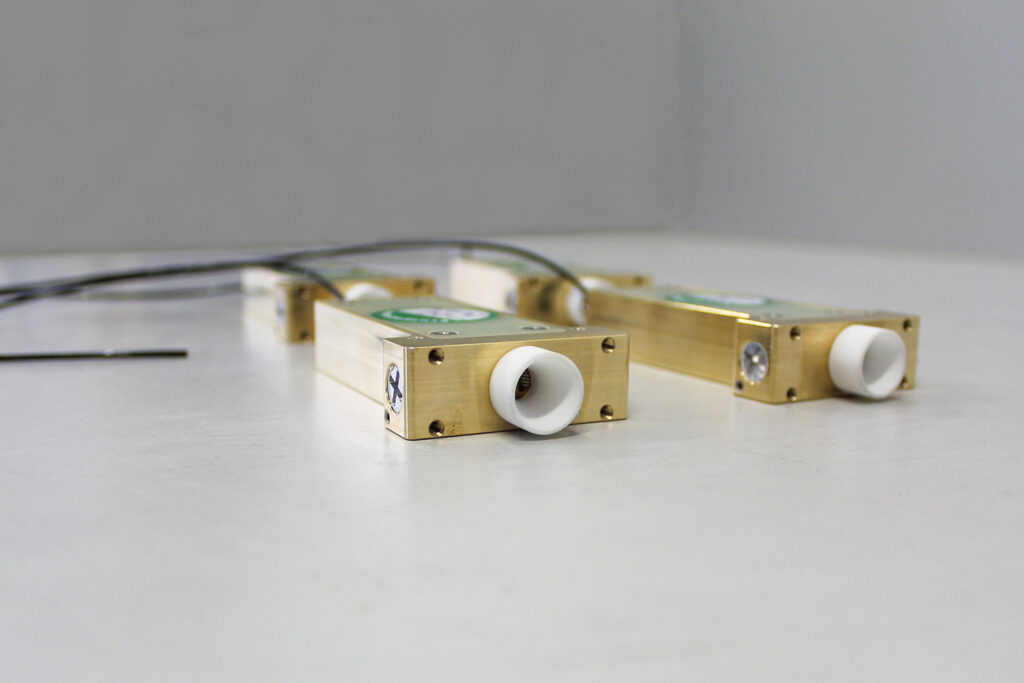
Testing cables without stripping the insulation. Our contact module makes contact at the front, is secured pneumatically and has completed over a million test cycles in endurance testing without any wear to the needle.
- Development and series production in Ehningen
- Standard modules in stock
- Part of the ATX Group
Why testing exposed cable ends often costs more than necessary
When testing cables with exposed ends, the cable is usually stripped or contacted through the insulation at the side. Stripping the cable is an additional step that takes time.
Inserting the probe from the side alters the cable end and often leads to false test results. This results in retests, good components being discarded and a first-pass yield that is lower than the actual quality level of your production.
The solution:
Front-side connection without stripping the insulation
We have solved this problem with our pneumatic contact module. The cable is inserted without stripping, secured pneumatically and made to contact at the end.
- No need to strip the insulation. The cable is inserted directly
and checked.
- Reproducible results. Two pneumatic
Pistons secure the cable with a constant force.
The test will not start until contact has been reliably established
is made from.
- Manual or automated. Whether operated manually or with a robotic feeder, the same module is used in both cases.
- The cable end remains unchanged. The insulation and strands remain undamaged, so the cable can be processed straight away.
- Free from dirt and maintenance. Proven in endurance testing with over a million test cycles.
- Versatile. As a single module or as a fully configurable workstation.
How the contact module works
1. Introduction:
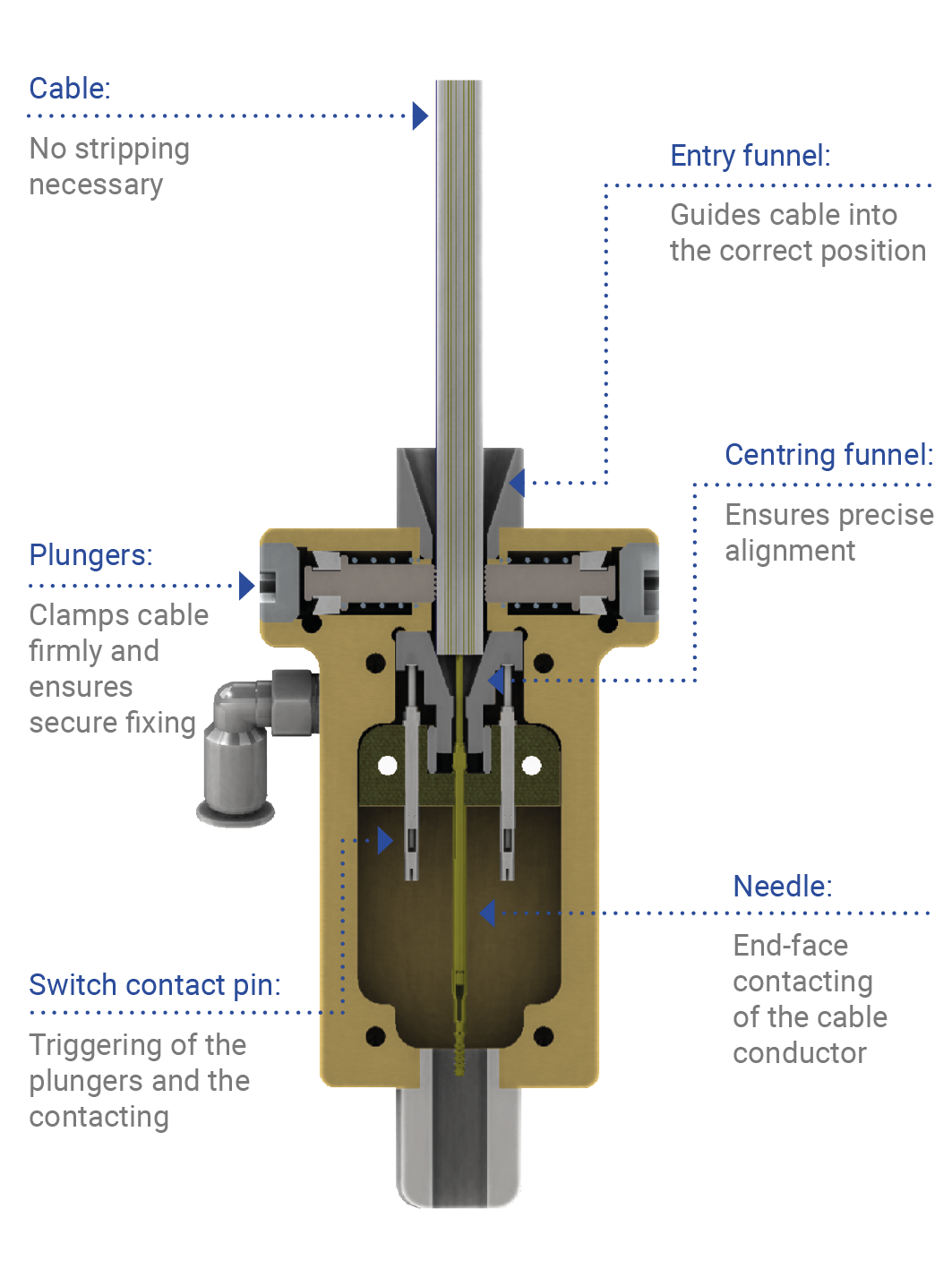
The cable is inserted into the connector module without first stripping the insulation.
2. Centre and secure:
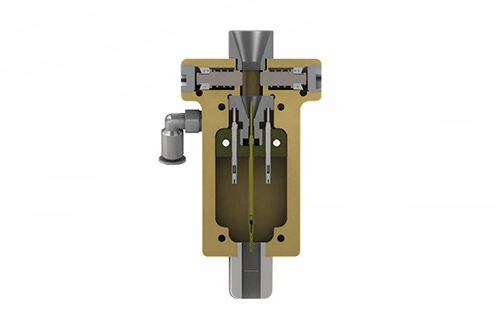
An entry and centring funnel aligns the cable. A switch contact pin activates two pneumatic pistons, which secure the cable with a constant force.
3. Contact:
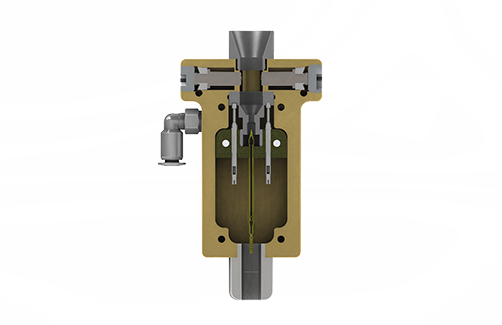
A probe makes contact with the cable core at one end. The insulation is not pierced in the process. The test only begins once a secure connection has been established.
4. Check:
Depending on the requirements: continuity test, resistance measurement or short-circuit test.
5. Removal:
An external signal, for example from the tester or via a pushbutton, releases the clamp. The cable is removed.
Over a million test cycles in endurance testing
In endurance testing, the contact module completed over a million test cycles. The result: no wear on the needle, no contamination and consistent repeatability.
A comparison of two methods
In action manufacturers of assemblies for drive technology, measurement technology and sensor technology.
How much does your cable test cost today?
Models and areas of application
1–4 mm²
Cross section
Also known as High-current version Available. From stock
Available.
6–16 mm²
Cross section
Also known as High-current version Available. From stock
Available.
On request
Cross section
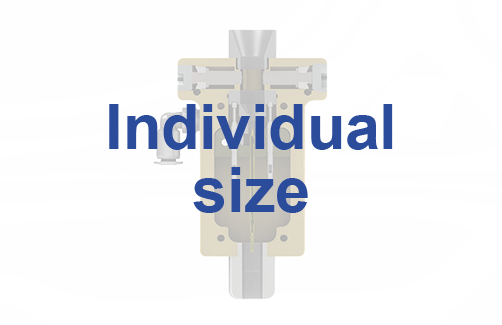
To meet specific requirements and individual needs, further cross-sectional dimensions are available on request.
Test the connector module on your own cables
Free sample test
Please send us two or three samples. We will test them on the contact module in Ehningen and record the process on video. If you wish, we can discuss the results during a brief online meeting.
The module itself is a purchase that, in most companies, does not require a lengthy approval process.
CONTACT NOW
We would be happy to advise you on your application and arrange a sample test or a loan module.

Rainer Kocher
Managing Director
Tel. +49 7031 7460-14
Email: rainer.kocher@leitec.info

Pavel Gross
Technical Support / Sales
Tel. +49 7031 7460-15
Email: pavel.gross@leitec.info
Frequently Asked Questions
No. The cable is inserted with its insulation intact and the contacts are made at the end.
No. The needle makes contact with the cable core from the front; the insulation and the strands remain undamaged.
Standard modules for 1–4 mm² and 6–16 mm², each also available in a high-current version, as well as an additional module for up to 0.5 mm² from an external diameter of approximately 1.2 mm.
Continuity test, resistance measurement and short-circuit test.
In endurance testing, it completed over one million test cycles with no wear on the needle, no contamination and with unchanged repeatability.
Yes. It can be operated manually with one hand or with a robotic feeder, using the same module.
The standard modules are available from stock.
Yes. The sample test with video documentation is free of charge, and you can test the loan module at your test station for four weeks free of charge.
